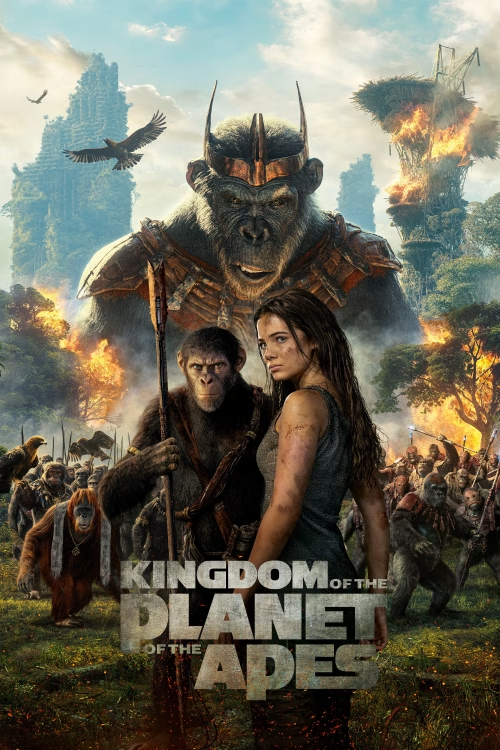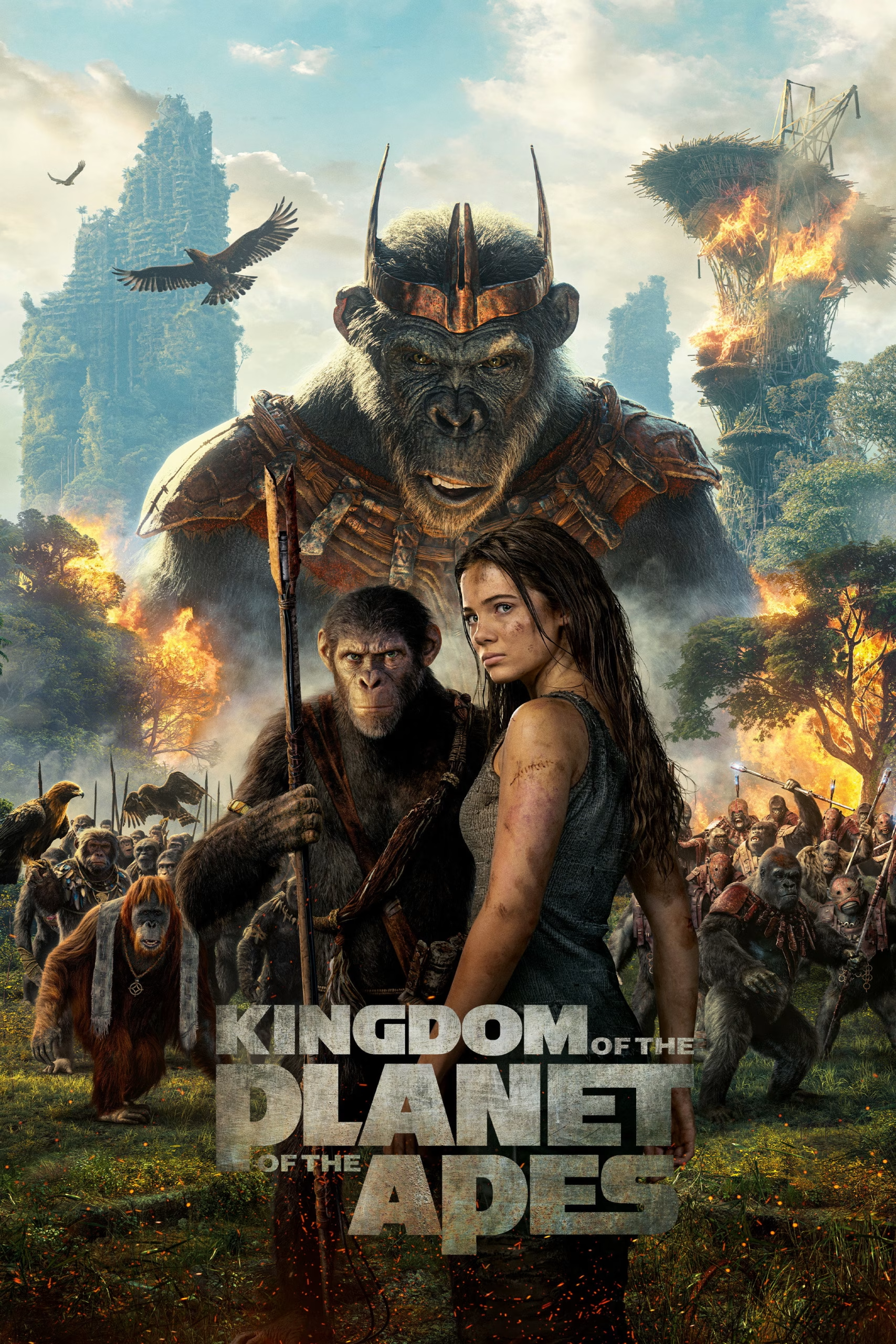
Kingdom of the Planet of the Apes moves the franchise far beyond Caesar’s lifetime and asks what happens when a leader’s ideas survive longer than the people who remember him correctly. Apes now dominate much of the world, human civilisation has been reduced, and different ape communities have built their own interpretations of history. The young ape Noa becomes the audience’s guide into that changed world after violence forces him away from the life he knows.
This spoiler-light guide focuses on legacy, leadership, knowledge and the relationship between Noa, Mae and the larger ape societies. For the stored synopsis, artwork and catalogue information, open the Kingdom of the Planet of the Apes movie page. You can also browse the broader Peleza Stream Movies library.
Noa gives the new era a character who has not inherited every answer
Noa is useful as a protagonist because he begins with a limited understanding of the world outside his community. He knows the traditions that shaped his clan, but not every version of ape history. When those assumptions are challenged, the audience learns with him.
That keeps the movie from feeling like a history lecture. Information matters because Noa has to decide what to trust and what kind of ape he wants to become after the world he understood is disrupted.
Caesar’s legacy has become a political tool
The earlier films built Caesar as a leader whose experiences shaped a particular moral philosophy. Generations later, his name carries authority even among apes who never knew him. That creates one of the movie’s strongest ideas: a symbol can be preserved while its meaning is changed.
Different characters use history for different purposes. Some treat it as guidance, while others use it to justify power. The question is not only what Caesar believed, but who gets to define that belief for a new generation.
Proximus Caesar turns knowledge into a form of control
Proximus is threatening because he understands that old human technology and information can change the balance of power. His ambition is not based only on physical strength. He wants access to knowledge that other communities do not have.
That makes the conflict feel larger than a battle between two apes. It becomes a struggle over who controls history, technology and the story being told about the future.
Mae complicates the idea that humans are simply part of the past
Mae matters because she does not fit the simplified picture many apes have of humanity. Her intelligence and objectives force Noa to reconsider what he has been told about the species that once controlled the world.
Their relationship works best when neither side is treated as completely transparent. Trust has to be negotiated, and each character has reasons to protect information. That uncertainty gives their journey tension even when they are moving toward the same immediate objective.
The eagle clan makes Noa’s loss feel specific
The film spends time showing the practices and relationships of Noa’s community before expanding the scale. That is important because “ape civilisation” is not one uniform culture. Different groups have developed their own identities, skills and beliefs.
Noa’s connection to the eagles therefore becomes more than visual decoration. It represents home, responsibility and a tradition he wants to protect without simply repeating everything unchanged.
The ruined human world remains part of every new ape society
Old structures, technology and records sit underneath the new world. The apes may be building their own civilisations, but they are doing it among the remains of another one. That creates constant questions about inheritance: what should be used, what should be feared and what should be left behind.
The setting gives the film a sense of archaeological discovery. A location can be both a ruin and a source of power depending on who understands what it contains.
What to watch for without spoilers
Pay attention whenever a character talks about Caesar. The details reveal more about the speaker’s priorities than they do about historical truth. Also notice which characters want knowledge shared and which want it controlled.
Noa’s development is closely tied to those choices. His growth is not simply about becoming stronger; it is about learning how to judge competing versions of the world without surrendering his own values.
Who is Kingdom of the Planet of the Apes likely to work for?
The movie is a strong fit for viewers who enjoy science-fiction adventures with political ideas, detailed world-building and characters forced to interpret history. Familiarity with the earlier Caesar trilogy adds context, but the new protagonist and time period give the story room to establish its own direction.
Go in knowing that Noa’s world is built from a distant memory of Caesar rather than direct experience. The most interesting part is watching him discover that legacy can inspire people, mislead them or be deliberately reshaped by whoever holds power.
Noa’s journey makes the franchise’s time jump easier to understand
Placing the story generations after Caesar could have made the new world feel disconnected from the earlier films. Noa solves that problem because he knows Caesar mainly as history rather than as a living figure. His limited knowledge mirrors the audience’s need to understand how the world has changed. Every new community, ruin and interpretation of Caesar therefore becomes part of the story rather than background exposition.
The result is a sequel that respects what came before without making Noa simply imitate Caesar. His choices matter because he has to decide what parts of the past deserve to be carried forward and what parts of the new world require a different response.