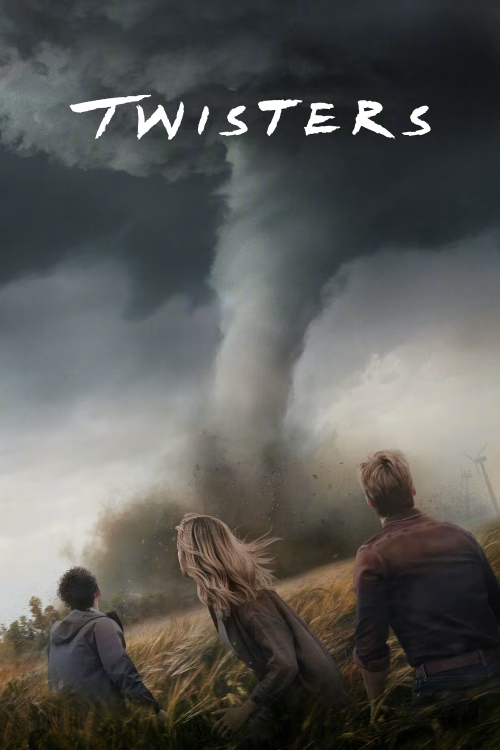
Twisters works best when the tornadoes are treated as more than visual spectacle. The story follows Kate Cooper, a skilled former storm chaser who has stepped away from the field after a traumatic encounter, before being drawn back to Oklahoma by Javi and a new research project. There she meets Tyler Owens, whose confidence and showmanship initially make him look like the opposite of Kate. The film gradually turns that contrast into its strongest idea: experience, technology and instinct only become useful when the people using them understand the human cost of the storms they are following.
This spoiler-light guide focuses on the movie’s characters, storm-chasing culture, science-inspired ideas and emotional structure rather than retelling every set piece. For the stored synopsis, artwork and title details, use the Twisters movie page on Peleza Stream. You can also browse the wider Peleza Stream movie library for more action and disaster titles.
Kate’s return to storm chasing gives the spectacle an emotional centre
Kate is not introduced as someone who needs to learn that tornadoes are dangerous. She already understands the weather and knows what a field decision can cost. That makes her return meaningful because the conflict is not about becoming fearless. It is about deciding whether expertise can still be part of her life after fear has become attached to it.
The movie uses that hesitation well. When Kate studies a sky, a radar image or a changing route, the moment carries two kinds of tension: professional judgement and personal memory. Her knowledge is real, but knowledge cannot make the environment safe. The result is a protagonist whose competence does not remove vulnerability.
Tyler Owens is more useful than a simple rival
Tyler arrives with the energy of a performer. His crew understands cameras, crowds and the excitement surrounding extreme weather. From Kate’s perspective, that can look reckless. The film becomes more interesting when it refuses to leave him as a shallow obstacle. His public image and his actual priorities are not always the same thing.
That gives Kate someone who challenges her assumptions as much as he challenges her methods. Their differences create friction, but the friction helps the story because it makes cooperation feel earned. A disaster film needs people to make decisions quickly, and Twisters gives those decisions more weight by first showing why the characters do not naturally trust one another.
The tornadoes stay readable because the objectives are clear
A large visual-effects sequence can become confusing if the audience cannot tell what the characters are trying to do. Twisters usually keeps the immediate objective simple: reach a location, collect data, get out of the path, protect people or decide whether a plan is still worth the risk. That clarity allows the weather to feel chaotic without making the storytelling chaotic.
The strongest sequences also keep nearby communities visible. Roads, homes, businesses and public spaces remind viewers that storm chasing is happening around people who did not choose to enter the danger. That distinction is important because it separates thrill-seeking from responsibility.
The science gives the story structure without turning it into a documentary
The film uses radar, field observations, tracking technology and meteorological language to give the teams believable tasks. Viewers do not need to understand every technical term to follow the story. The central idea is simpler: more information can improve judgement, but no instrument can make a violent storm completely predictable.
Some of the experimental concepts are heightened for blockbuster storytelling, so it is better to treat them as science-inspired plot devices rather than instructions for real-world storm intervention. What matters dramatically is the tension between what the characters can measure and what they still have to decide under pressure.
Kate, Javi and Tyler represent different ways of handling risk
Kate brings experience shaped by loss. Javi brings organised research and technology. Tyler brings instinct, confidence and a public-facing storm-chasing culture. None of those approaches is presented as enough by itself. The movie improves as those methods start borrowing from one another.
That makes the action scenes more than survival tests. They also become tests of judgement: whose information matters, when a plan should change, and whether a character is chasing a result or responding to what is happening around them.
Why the Oklahoma setting matters
The open landscape gives the storms scale. Long roads and wide horizons let the audience see danger developing from a distance, which creates a different kind of suspense from a threat that appears suddenly. The characters can often see what is coming and still have very little time to choose correctly.
The setting also helps the movie connect spectacle to community. The storms move through places where people live, not empty arenas created only for action. That makes the best decisions in the film the ones that recognise a radar signature is not just data; it can represent homes and people directly in the path.
What to watch for without spoiling the major turns
Pay attention to first impressions. The film introduces people through team identities, vehicles, cameras and reputations, but those labels do not fully explain what they value. Notice who changes a plan when the human cost becomes clearer and who treats information mainly as a competitive advantage.
Also watch the way Kate’s confidence changes. Her arc is stronger if it is read as learning to act with fear rather than eliminating fear. Preparation, attention and collaboration become more important than bravado.
Who is Twisters likely to work for?
The movie is a natural fit for viewers who enjoy disaster adventures with clear objectives, strong momentum and a character story running underneath the spectacle. It also works for audiences who like professional competence stories where people have to combine different skills under pressure.
Go in knowing the basic setup rather than every plot turn: Kate returns to Oklahoma, Javi brings a research mission, Tyler represents a very different storm-chasing culture, and increasingly dangerous weather forces those worlds together. The rest works best when the film is allowed to reveal which assumptions about the characters were correct and which ones need to change.